

Coinciding with Direct Aid’s goal in providing basic education in the neediest societies in Africa, a great interest in technical, vocational and literal training and applied education, in response to the remarkable need in African societies to develop its activities aimed at creating qualifications for students from basic education outputs (graduates of primary stages preparatory and secondary schools) alongside unlettered and unemployed students, due to the effective director of professional training, vocational training and technical education from an effective enhancement in human capital development, which is more effective and not comparable to the course of basic and academic education that may take way longer to integrate the student in the labor market for a period of no less than 16 years, while the effective training and vocational education paths can reduce this period to less than six months only to make the student hold a suitable qualification for a job opportunity, and technical education and vocational training paths constitute a lifeline for those who were not able to complete educational paths and seek decent work. The vocational education system and craft training that Direct Aid Association provides, works to integrate with the African labor market through qualified centers capable of qualifying professional and craftsmanship competencies that work to provide professional training with high international standards.
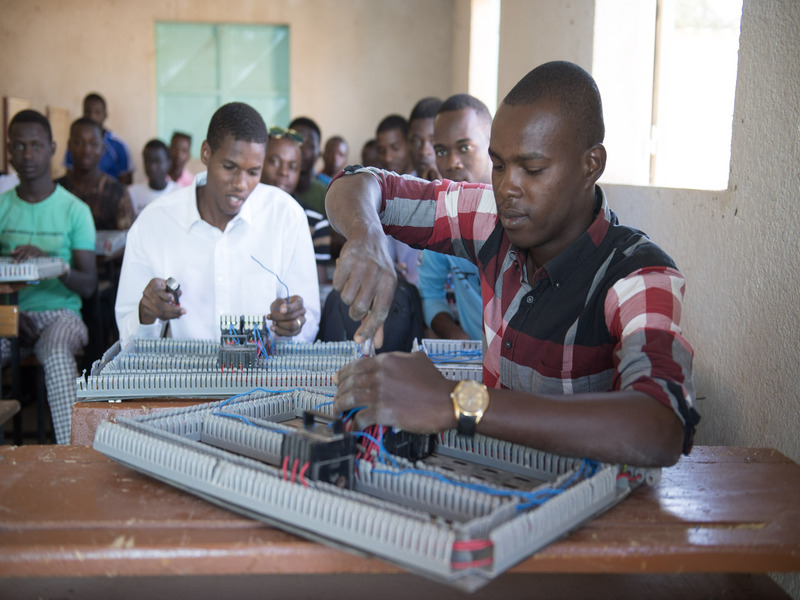
Direct Aid Association has established 108 vocational training centers, built within different areas, totaling 7,870 square meters. These centers are spread across 20 African countries, and include 51 computer centers, with 834 usable computers, and 39 sewing and embroidery centers, containing 550 sewing and embroidery machines. In addition to 18 vocational training workshops teaching electricity, carpentry, blacksmithing, and mechanics. These workshops contain 123 working equipment.
Technical and vocational education and training centers of the Direct Aid Association have provided their services to more than 28,000 beneficiaries in the societies surrounding the association’s centers, and despite the incomplete approval of the majority of the association’s training centers to issue accredited certificates by the countries in which they operate, the centers provided educational opportunities for local and private communities graduates of the association’s orphans, who numbered nearly a thousand graduates annually, and within the periodic evaluation work for the association’s activities, the need for vocational training centers in the association to develop their performance and to maximize their benefit in increasing the provision of training opportunities , skill and development services that work to further contribute to the development of societies surrounding the association’s centers; Therefore, a committee has been formed to develop the technical and vocational education and training centers of the Direct Aid Association for a period of 10 years.
Direct Aid’s plan to develop vocational training for a period of 10 years during the period of 2022 – 2032 focused on identifying 4 main training tracks that consist of:
1) The craft training track: which focuses on establishing training incubators in sewing and embroidery, industrial training incubators, and more, with set targets for those who drop out of primary school and the following stages. The duration of study in one training course does not exceed 4 months, with the trainee receiving a certificate of passing the course that qualifies them to work in the private sector or independently.
2) The path of vocational training and continuing education: This path focuses on qualifying individuals without requiring an academic certificate, however the trainee must have basic experience in some fields. The path accommodates the outcomes of the preparatory stage and those who drop out of the subsequent stages, and the trainee is given certificates that vary according to the number of hours. Training and the certificates issued by this track for the trainee focus on A) Training diploma, B) Certificates of attendance for short training courses.
3) The applied basic education track: which is an extension of the basic education track. Students cannot join stages without completing the stage that precedes it. The highest certificate that can be obtained in this track is the preparatory or secondary certificate with its branches (industrial secondary – commercial secondary – agricultural secondary and others), and the education periods are suitable for the middle or high school years.
4) The higher technical education track (technical college): which is an extension of the basic education track (part of the higher education system), and the student cannot join the stages without completing the stage that precedes it, and the highest certificate that can be obtained in this track is the Higher Technical Diploma, which is an academic certificate obtained by the student after passing two or three academic years according to the French systems. This path contributes in providing job opportunities in the government and private sectors, in addition to working independently.